Field report 01 · EDS × CosmoNutz · 12 August 2026
When the
sky blinked.
A custom environmental station watched a 97.9% partial solar eclipse unfold—one complete minute at a time.
Minimum recorded light
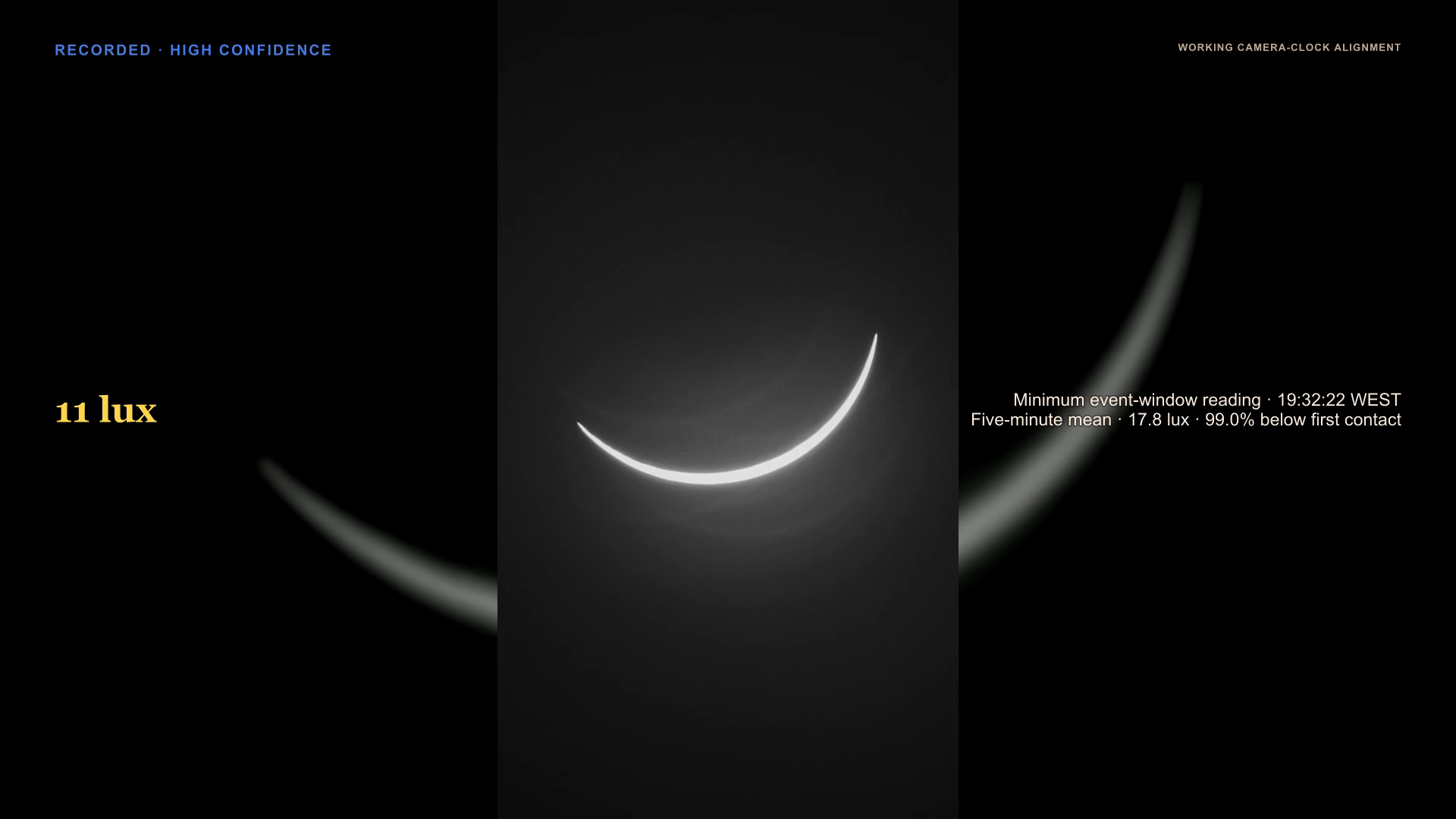
11 lux
19:32:22 WEST · 8 s after Espinho predicted maximum
00
Experience
Synchronized event replay
Earth + sky · one working timeline
Replay the eclipse.
Scrub 111 one-minute station readings beside the telescope sequence across the complete event window.
Replay the eclipse01:55:36 · 18:29:57–20:25:33 WEST
- 01 Earth witness
- EDS · Espinho coastal site111 complete one-minute observations
- 02 Sky witness
- CosmoNutz · Vila Praia de Âncora areaImage sequence ends 19:55:38 WEST · precise position withheld
- ↔ Working alignment
- Network-synchronized acquisition timeEDS continues alone after the camera record ends
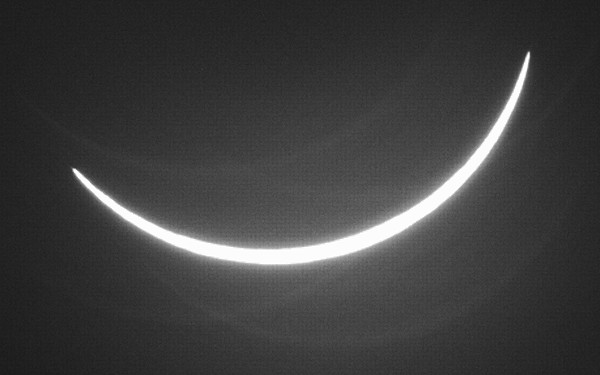
Time-aligned telescope still
Method note
Acquisition devices used network-synchronized system time. Alignment is operationally reliable for reconstruction, but not independently verified against a dedicated precision timing reference. Provenance →
01 Abstract
The short version
The light result is decisive.
The thermal result is subtle.
EDS captured an unmistakable eclipse signature in ambient light. The minimum landed inside the one-minute sample containing the Espinho predicted astronomical maximum, then light increased while the Sun continued moving toward the horizon.
Temperature and humidity changed too, but the preselected matched evenings in this archive show that most of those changes overlap ordinary coastal sunset behavior.
Eclipse detection through illuminance.
Small enhancement of evening cooling.
Humidity, pressure, or dew response caused by eclipse.
↳ Verify it · archive it
Stable public artifacts
The record remains
inspectable at every layer.
The report, synchronized replay, field records, source data, media manifests, and reproduction notes live in one self-contained static bundle.
Replay
Synchronized event replay
Scrub the telescope proxy, discrete one-minute telemetry, control envelope, and the data-only epilogue after the camera stops.
Film 6:20 review masterThe museum-style field film stays cautious on temperature attribution while making the light result legible to a general audience.
Notes Source analysisThe long-form Markdown analysis names the defensible claims, control logic, and known limits without presentation-layer compression.
Script Dependency-free asset generatorThe Python script documents the expected telemetry export and writes the SVG, JSON, and compact event-window CSV used by this archive.
Field archive Observation contextCurated station and telescope records with explicit metadata gaps instead of inferred captions or locations.
Manifest Stable archive mapA machine-readable inventory of the primary report, data, replay, provenance, field records, and media verification files.
02 Astronomical context
A near-total sunset eclipse
One hour, fifty minutes
of changing light.
Espinho remained outside the narrow path of totality. The station experienced a 97.9% partial eclipse, beginning with the Sun around 22° above the horizon and ending near 1°.
First contact
18:35:08 WEST · Sun ≈ 22°Espinho predicted maximum
19:32:14 WEST · 97.9% coverageLast contact
20:25:33 WEST · Sun ≈ 1°Circumstances cross-checked against the local Espinho eclipse calculation and NASA's 2026 eclipse overview.
03 Primary evidence
Ambient illuminance
A V-shaped signature
centered on Espinho maximum.
The yellow trace is the eclipse evening. The dashed line and blue envelope summarize 12 nearby evenings at the same local times.
The 11-lux sample followed the Espinho predicted maximum by only eight seconds.
The five-minute mean collapsed from 1,818.4 to 17.8 lux.
Light increased after maximum despite the continuing sunset.
04 Counterfactual
What would sunset normally do?
A sunset curve
should not make a V.
Each evening is normalized to its own light level at first contact. This removes much of the bias from different starting brightness and exposes the distinctive event shape.
Every control evening continued to darken during the 15 minutes after maximum, declining by 101.6–436.8 lux. The eclipse evening instead recovered by 229.4 lux. A passing cloud could create a brief brightness change, but the depth, timing, and direction reversal together make the eclipse the best-supported explanation in this dataset.
05 Environmental response
Temperature, humidity, dew point, pressure
Interesting traces.
Careful conclusions.
The eclipse curves are shown as changes from first contact. Dashed lines represent the two closest pre-event evenings; the shaded regions show the wider control distribution.
Temperature
−1.59 °COnly 0.19 °C more cooling than the preselected matched evenings by maximum. Plausible, but not separable with confidence.
Humidity
+5.27 ppThe preselected matched evenings rose 5.49 points. This looks like normal relative-humidity response to evening cooling.
Dew point
−0.36 °CMuch steadier than air temperature. Saturation tendency increased, but no distinct eclipse-driven dew event is established.
Pressure
+0.23 hPaFully inside normal nearby-day variability and too confounded for eclipse attribution.
06 Sensor snapshot
Five-minute centered means
Move through
the event.
Choose a stage to inspect the local environment. The printable report presents the Espinho maximum-window state.
Espinho predicted maximum
19:32:14
WEST
- Light
- 17.8 lux
- Temperature
- 23.73 °C
- Humidity
- 75.26%
- Dew point
- 19.09 °C
- Sea-level pressure
- 1020.38 hPa
- Dew spread
- 4.64 °C
07 Method & data quality
Independent field science, disciplined method
Simple enough to explain.
Careful enough to trust.
This is an observational field study, not a controlled experiment. The goal is to extract the strongest defensible evidence without disguising uncertainty.
Read-only extraction
18,442 read-only EDS rows from 5–17 August were used for the wider comparison export, with no database changes.
Five-minute means
Centered averaging uses all samples within ±150 seconds of each target time, reducing the influence of any single noisy reading.
Twelve controls
Nearby evenings were compared at the same local clock times.
Matched evenings
9 and 10 August are bundled as preselected matched evenings based on pre-contact similarity; the selection rule is documented, not computed inside this archive.
Change from baseline
Environmental curves are expressed relative to first contact.
Independent timing
Espinho astronomical contact times were sourced independently. Telescope acquisition used network-synchronized system time; alignment is operationally reliable for reconstruction, but was not independently verified against a dedicated precision timing reference.
Capture integrity
Every minute accounted for.111 event-window readings · mean interval 60 s · maximum interval 60 s · no dropout between first and last contact
100%
08 The instrument
A small station with a long memory
The observer was already outside.
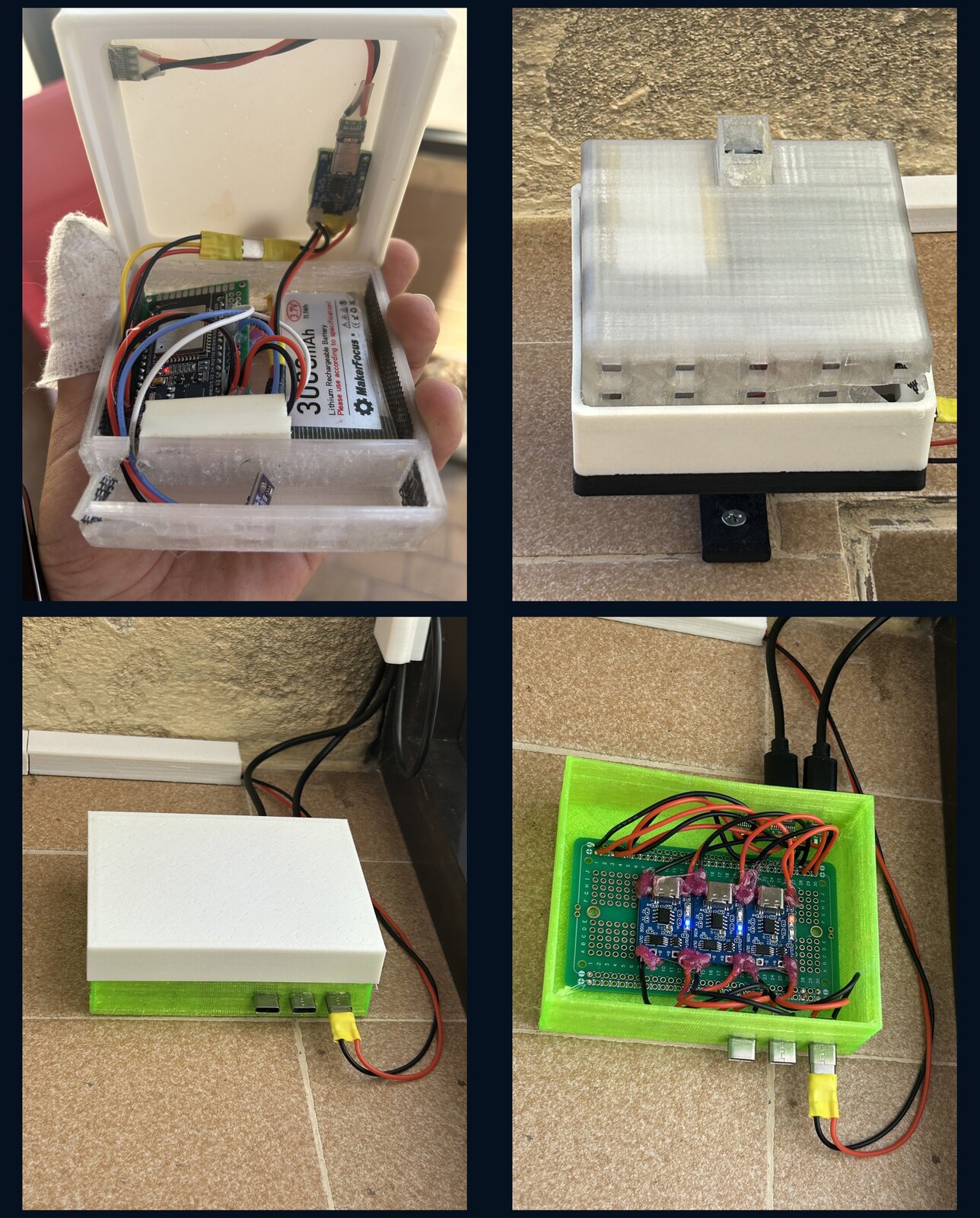
EDS combines a BME280 environmental sensor, BH1750 illuminance sensor, battery telemetry, and continuous time-series storage. The eclipse was not a staged experiment: it was captured because the station was already operating as a persistent local observer.
The BH1750 record is used here as comparative lux, not calibrated solar irradiance. The archive also does not bundle independent wind or cloud observations, so environmental attribution stays deliberately modest.
- 01 Air temperature, humidity, and pressure
- 02 Ambient light in lux
- 03 Derived dew point and sea-level pressure
- 04 Battery and signal-health context
- 05 One-minute continuous telemetry
F Field archive
Physical context · curated evidence
The instruments belong
inside the record.
These are archival records, not a social gallery. Every entry identifies its role and instrument; unresolved dates and equipment details remain explicit, while the telescope location is documented only at public locality level.
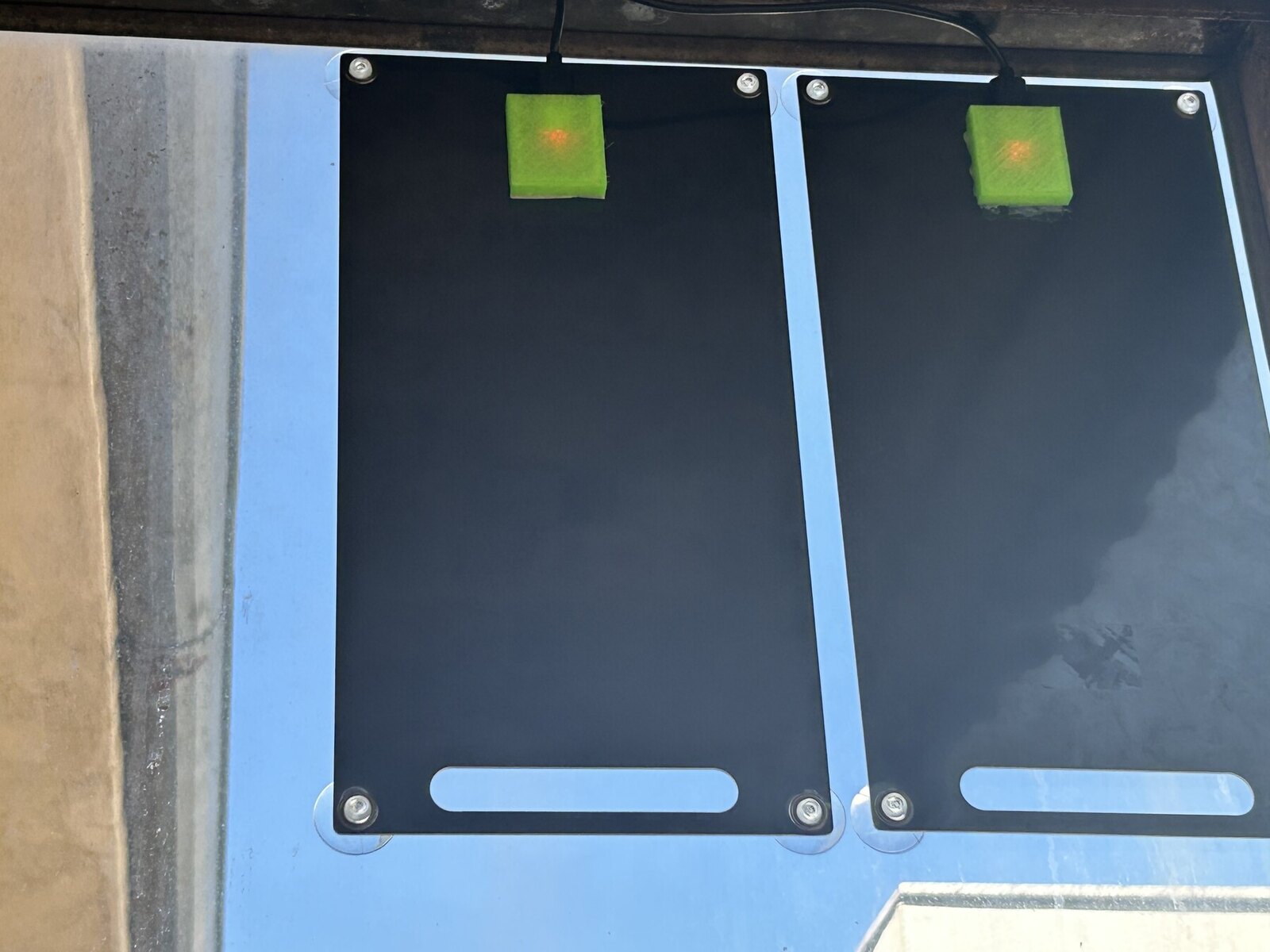
Instrument context · EDS
Station enclosure, electronics, and solar supply
New documentary views identify the environmental observer and its power system. The photographs were captured after the event and are presented as hardware context, not eclipse-day evidence.
Derived still · Sky witness
Espinho first-contact reference
18:35:08 WEST · network-synchronized acquisition alignment
Derived still · Sky witness
EDS minimum reference
19:32:22 WEST · Vila Praia de Âncora area · precise position withheld
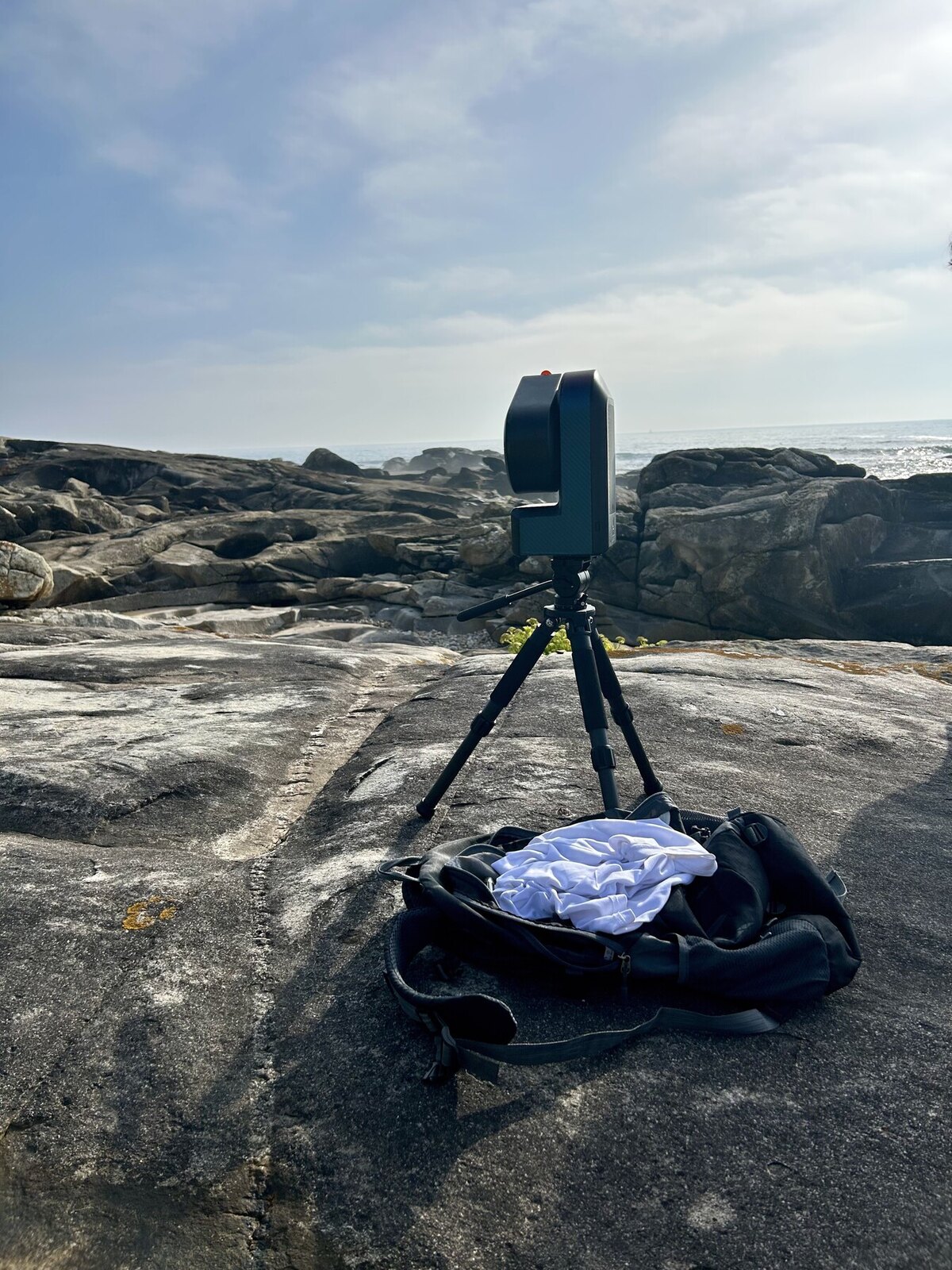
Known record gap: complete telescope filter and accessory notes are not present in this public repository. A verified eclipse-day setup photograph now documents the observing context; the public record identifies only the Vila Praia de Âncora locality and intentionally withholds the precise position.
09 Interpretation
What this field report supports
A very strong detection.
A deliberately modest claim.
The eclipse is written unmistakably into the light data.
The timing, depth, and rebound agree with the astronomical event and separate cleanly from nearby evenings.
A small thermal contribution remains plausible.
Cooling was slightly stronger than the preselected matched evenings, but the estimated excess was only 0.15–0.19 °C.
No unique humidity, dew, or pressure effect is established.
Those traces overlap routine coastal sunset behavior and lack independent wind or cloud controls.
Archive assessment
This is a strong EDS case study precisely because it contains both a spectacular result and a boundary. The system detected a celestial event almost to the minute while also showing why scientific storytelling must distinguish correlation from attribution. That combination—wonder plus restraint—is stronger evidence than an exaggerated weather claim.
10 Limitations & next study
What limits the conclusion
One event.
One station.
One sunset.
- No direct cloud-fraction or wind measurement
- Eclipse and normal evening cooling overlap
- Air temperature responds more slowly than light
- Local airflow and enclosure lag may matter
- Lux is used comparatively, not as calibrated irradiance
What to do next
Turn one beautiful trace
into a repeatable protocol.
- Add independent cloud, wind, and visibility observations.
- Fit expected sunset curves and examine lagged residuals.
- Quantify enclosure thermal lag on stable clear evenings.
- Preserve this as a named EDS event window.
- Repeat across multiple stations and future eclipses.
11 Published visual record
Preserved derivatives
One dataset.
Reusable visual records.
Use the SVG masters for layout work and the PNG exports for direct posting, presentations, and documents.
11A Film package
Moving-image archive
The same evidence,
cut for different audiences.
Every cut keeps the same scientific boundaries: decisive light detection, a possible small thermal contribution, and no claimed unique humidity, dew-point, or pressure effect.
 Primary film · 06:20
Review master
The Sky Blinked
The complete landscape museum cut: two observational witnesses, synchronized evidence, and the scientific limits kept visible.
Watch review master
Primary film · 06:20
Review master
The Sky Blinked
The complete landscape museum cut: two observational witnesses, synchronized evidence, and the scientific limits kept visible.
Watch review master
Derivative cuts
90 s · TechnicalScience cutFive shorter edits for technical, exhibition, and vertical formats.
Confidence-led summary for technical viewers and short presentations.
Watch → 90 s · ExhibitionSilent exhibition loopGallery-safe loop with no narration and disclosed telemetry framing.
Watch → 60 s · VerticalVertical social cutMaximum, reversal, and restraint in a concise mobile format.
Watch → 30 s · VerticalVertical explainerThe reversal against sunset does most of the scientific storytelling.
Watch → 15 s · VerticalEspinho maximum revealEspinho predicted maximum, 11 lux, and the eight-second offset.
Watch →12 Data appendix
Eight minutes around maximum
The raw minimum,
row by row.
Times below are local WEST. Values are unaveraged one-minute station readings.
| Time | Lux | Temp °C | RH % | Dew °C | SLP hPa |
|---|---|---|---|---|---|
| 19:28:22 | 59 | 23.84 | 75.56 | 19.26 | 1020.29 |
| 19:29:22 | 40 | 23.80 | 75.23 | 19.15 | 1020.36 |
| 19:30:22 | 24 | 23.79 | 75.13 | 19.12 | 1020.36 |
| 19:31:22 | 14 | 23.79 | 74.84 | 19.06 | 1020.36 |
| 19:32:22 | 11 | 23.72 | 75.13 | 19.05 | 1020.38 |
| 19:33:22 | 15 | 23.68 | 75.05 | 18.99 | 1020.40 |
| 19:34:22 | 25 | 23.66 | 76.14 | 19.21 | 1020.42 |
| 19:35:22 | 40 | 23.64 | 76.58 | 19.28 | 1020.43 |
13 References & provenance
Sources
- NASA — Total Solar Eclipse on 12 August 2026
- Local Espinho eclipse circumstances
- Espinho public eclipse notice
- EDS live
device_dataread-only export, captured 18 August 2026
Reproducibility
The visual assets and derived public dataset are generated by:
scripts/generate_eclipse_assets.py
The script expects a read-only telemetry CSV export and writes only into this archive's local assets/ tree. The bundled 111-row CSV is public-safe, but it is not sufficient by itself to reproduce the wider control metrics or matched-evening selection.
Replay proxy settings and current-file checksums are preserved in the proxy manifest. The originals remain outside the public archive.
Instrument provenance
Machine-readable provenance recordResearch & engineering
Teófilo Couto
Environmental instrumentation, sensing and telemetry systems, software engineering, field observation, telescope acquisition and astrophotography, data analysis, scientific visualization, synchronized replay, reproducibility, archive engineering, and deployment.
EDSEnvironmental witness
CosmoNutzOptical and astronomical witness
MDNTIndependent research and engineering laboratory
EDS
Environmental Data Station
Independent field report · 18 August 2026